You’ll most likely nonetheless have an electrical utility invoice after going photo voltaic. Most householders want to purchase energy from the grid at evening and when their panels aren’t producing sufficient electrical energy. Nevertheless, photo voltaic panels ought to cut back electrical energy payments; in some instances, your invoice might go to zero.
How does billing work when you’ve got photo voltaic?
The scale of your electrical invoice after putting in photo voltaic panels depends upon your particular scenario. Each state has its personal rules, utilities provide totally different charges and choices, and every house is exclusive.
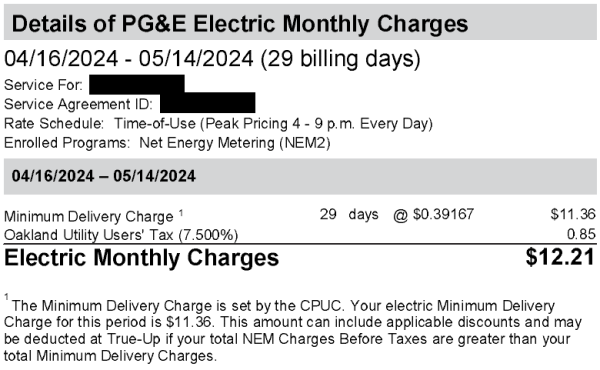
For instance, right here’s my electrical invoice for Could 2024 as a photo voltaic buyer in California’s Pacific Fuel and Electrical Co. (PG&E) service territory.
How a lot will I save on my electrical invoice with photo voltaic?
How a lot you’ll save in your electrical invoice with photo voltaic depends upon seven key components:
-
Whether or not your photo voltaic system is sized to cowl your entire electrical energy consumption.
-
What number of hours of daylight your property will get.
-
Your utility’s electrical energy charges and charge buildings.
-
Your utility’s web metering or web billing export charge.
Do photo voltaic panels actually cut back electrical energy payments?
Electrical payments could be difficult to navigate, and there’s no one-size-fits-all instance. However by familiarizing your self with these key ideas, you’ll be capable of perceive what your electrical invoice might seem like after getting photo voltaic:
-
Internet metering and web billing.
-
True-up statements.
-
Mounted costs.
-
Nonbypassable costs.
-
Sorts of utility charge plans.
Internet metering and web billing
Internet metering is a billing mechanism through which the utility firm credit your electrical invoice, normally on the retail charge, for extra photo voltaic electrical energy you generate and ship to the ability grid.
-
Though web metering is obtainable in lots of areas, not all states or utilities provide it.
-
Some states, corresponding to California and Arizona, have been transitioning away from web metering and towards one thing known as web billing, through which the credit you get for sending energy again to the grid are decrease than the retail charge.
-
How web metering exhibits up in your electrical invoice depends upon your state and utility. You may get your assertion credit score month-to-month or yearly.
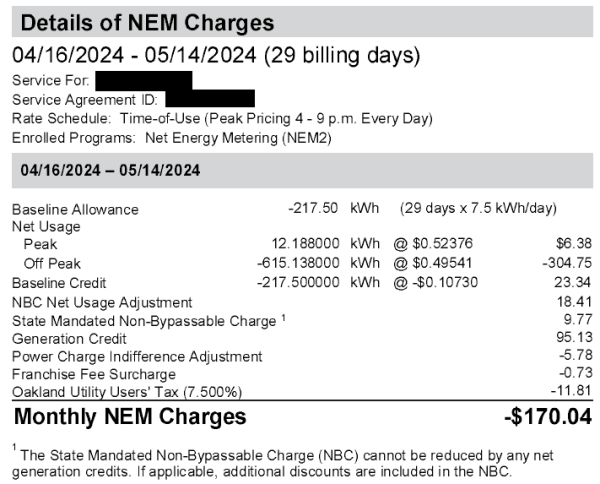
Right here’s an instance of NEM cost particulars from my invoice. The full is damaging as a result of my photo voltaic panels have been producing a variety of power throughout that interval, so I used to be sending extra electrical energy to the grid than I used to be pulling from the grid. Within the winter months, the scenario is reversed. Brief, cloudy days imply my panels typically don’t generate sufficient energy, so I take extra energy than I give to the grid.
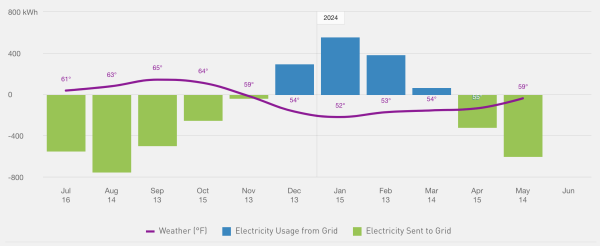
The electrical energy my house pulled from and despatched to the grid every month for a 12 months.<br>
My utility firm exhibits the month-to-month web metering stability for informational functions solely; it reconciles my account yearly through a true-up assertion.
True-up statements
A real-up assertion is a proper accounting of how a lot electrical energy you took from the grid and despatched to the grid over a selected time period. If the utility firm reconciles web metering credit yearly, you’ll get a true-up assertion every year. If the quantity of electrical energy you used from the grid over the 12 months was higher than the quantity you despatched to the grid, the true-up invoice is what your utility will cost you for that stability. If you happen to produced extra power than you used, that is when you could be compensated for the surplus quantity, relying in your state and utility
.
For my house, that’s anticipated to be a bit beneath $20 for 2024. On my NEM abstract, you may see the point out of a true-up assertion:
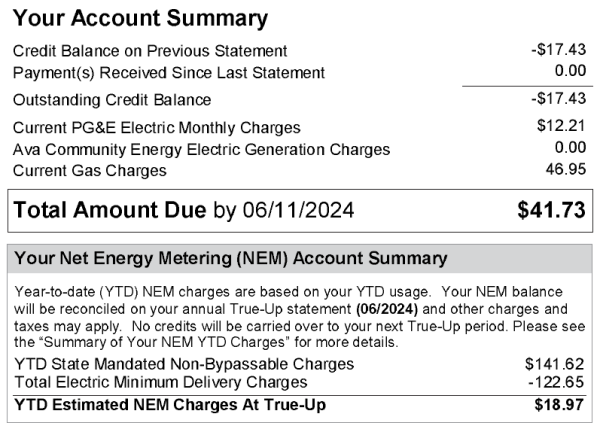
You’ll be able to keep away from having to pay something at your annual true-up by sizing your photo voltaic system to cowl all of your electrical energy wants.
Mounted costs
In lots of states, utility firms make all prospects pay fastened costs for electrical energy. Usually, these are to keep up the ability grid for everybody, together with photo voltaic prospects. Mounted costs could also be listed in your invoice in some ways, corresponding to service costs or customer support charges.
In case your utility firm has fastened costs, the one option to get your electrical invoice to zero is to offset these costs by producing extra photo voltaic power than you utilize. That may be robust to do if the utility firm pays little to purchase that extra electrical energy from you. For instance, beneath NEM 3.Zero in California, the export charge for photo voltaic power despatched again to the grid is so low that it’s not value attempting to compensate for fastened costs by producing extra photo voltaic.
Nonbypassable costs
Some states mandate nonbypassable costs, or NBCs, for all utility prospects; you may see them on my invoice above. Because the title suggests, you may’t keep away from these costs, even in case you have photo voltaic. Relying on the state and utility, nonbypassable costs might pay for packages corresponding to energy-efficiency packages, help for low-income prospects, storm restoration or environmental packages
, . States implement nonbypassable costs in several methods.
Sorts of utility charge plans
Utilities cost various kinds of charges; the next are the commonest.
Mounted charges
Beneath this kind of plan, you pay a set quantity per kilowatt-hour (kWh) of electrical energy you pull from the grid, which means the worth is similar whatever the day or time of day. Your invoice depends upon how a lot electrical energy you pull from the grid, however the charge per kWh stays the identical.
Variable charges
Beneath this kind of plan, what you pay per kWh fluctuates relying on provide and demand circumstances. Accordingly, if energy demand is low, you’ll pay much less for the electrical energy you pull from the grid; if demand is excessive and provide is low, you’ll pay extra.
Time-of-use (TOU) charges
Beneath TOU plans, the utility costs a value that extra intently corresponds to what the utility should pay to generate or purchase that energy. For instance, on a sizzling summer time day when many individuals are counting on air con, demand on the grid will increase and so provide should additionally improve, which will increase the utility’s value to generate electrical energy. That is very true within the early night hours when individuals come house from work. TOU charges can shift in accordance with the time of day and the season
.
On my electrical invoice, you may see that I paid extra per kWh for electrical energy throughout peak hours than throughout off-peak hours. In PG&E’s service territory, as in lots of areas, photo voltaic prospects are required to be on a TOU charge plan
.
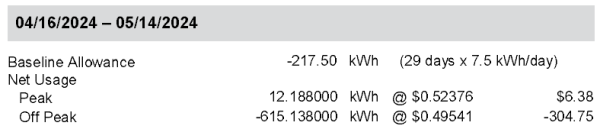
Throughout off-peak hours on this billing interval, my photo voltaic system was producing extra electrical energy than I used to be pulling from the grid; that’s why there is a damaging quantity on that “Off Peak” line. I might cut back my invoice by avoiding utilizing home equipment like my washer and dryer throughout peak hours. On my TOU charge plan, peak pricing happens between four p.m. and 9 p.m. every single day — when my photo voltaic system isn’t producing a lot electrical energy.
Tiered charges
Beneath a tiered charge plan, often known as an inverted charge system, you pay one charge per kWh in case your utilization stays under a sure threshold; you pay the next charge per kWh in case your utilization exceeds that threshold. Tiered charge plans, utilized in some states, are supposed to encourage prospects to make use of much less electrical energy. Since you’ll pull much less electrical energy from the grid with photo voltaic, you’re much less possible to enter the next tier. That is a technique that photo voltaic can assist you save in your electrical invoice
.
Demand costs
Some states impose demand costs on residential prospects, and these costs have gotten extra frequent. Demand costs are based mostly on spikes in your power demand. Your house may very well be utilizing a comparatively small quantity of power, however spikes throughout peak occasions can improve your electrical energy invoice dramatically. It’s because your utility has to maintain sufficient energy on-line to supply electrical energy for these spikes at any time when they occur. Though a photo voltaic system can assist decrease demand costs by decreasing your electrical energy use, it gained’t assist in case your use spikes at a time once you’re not producing as a lot photo voltaic power.
Get extra good cash strikes – straight to your inbox
Join and we’ll ship you Nerdy articles concerning the cash subjects that matter most to you together with different methods that will help you get extra out of your cash.

What’s a kWh?
The abbreviation kWh stands for kilowatt-hours, which is how your property’s electrical energy use is measured in your invoice. A kWh represents the quantity of electrical energy used over an hour. Utilizing a 1,000-watt equipment for one hour takes 1 kWh of electrical energy whereas utilizing a 60-watt mild bulb for an hour takes 0.06 kWh.
Can I save much more with a house photo voltaic battery?
A house photo voltaic battery shops your solar energy for later use. This will decrease your month-to-month electrical payments considerably in a number of circumstances:
-
If the export charge for photo voltaic in your space is low, you may retailer power in your battery to make use of later as a substitute of promoting it again to the grid.
-
If you happen to’re in an space with time-of-use charges, a battery can assist you keep away from utilizing power from the grid at occasions when it’s costlier.
-
A battery can assist you keep away from demand costs, if you happen to’re topic to these in your space.
Nevertheless, batteries are costly. They value between $12,000 and $22,000 earlier than the 30% federal tax credit score
.